
With warehouse racks, words matter. The right terms prevent errors, save money, and improve safety. This guide helps you communicate clearly with designers, suppliers, and installers.
Why Understanding Warehouse Rack Terminology Matters
When you buy or design racks, you use words to turn needs into real steel. If the words are not right, the racks will not be right either.
You may think a term is clear. Your supplier may read it in another way. This gap often leads to layout errors, low space use, or safety risks. You may also pay for capacity you never use.
This article is for you if you are a warehouse owner, project manager, engineer, dealer, or buyer. When you use the right warehouse rack terminology, you make faster decisions and avoid rework.
Basic Warehouse Rack Terms
Warehouse Rack / Storage Racking

A warehouse rack is a steel structure made to store palletized or heavy goods. It is fixed to the floor and works with forklifts or similar equipment.
You should not confuse racking with shelving. Shelving is often lighter and used for hand picking. Racking is for pallets and machines.
If you use the wrong word when ordering, you might get racks that cannot hold your weight.
Pallet Racking

Pallet racks are the most used system in warehouses. They hold goods on pallets. Forklifts load and take the pallets from the rack.
You will find pallet racks in distribution centers, factories, and logistics hubs. They work best for storing a wide variety of items that you need to get to quickly.
Load Capacity / Load Rating

Load capacity tells you how much weight the rack can hold safely.
You must separate two ideas:
– Load per level means weight on one beam level.
– Total load means weight on the full bay.
If you mix these two, you risk overload and collapse.
Bay / Rack Bay
A bay is one storage unit between two upright frames.
A single bay holds a fixed number of pallets. A multi-bay system links many bays together. When you plan space, bay size controls cost and layout.
Upright & Beam Terminology
Upright / Upright Frame

An upright frame is the vertical structure of the rack. It includes columns and bracing.
You often see upright height and upright depth in drawings. Height sets how many levels you can build. Depth must match pallet size.
Beam / Cross Beam

A beam supports the pallet load. It connects two uprights.
Different beam profiles carry different loads. Box beams and step beams are common. If you choose the wrong beam type, you lose capacity.
Beam Level
A beam level is one horizontal storage layer.
You can adjust beam levels up or down. Adjusting shelf heights a little can fit more pallets and use space better.
Bracing (Diagonal / Horizontal Bracing)

Bracing keeps the rack stable.
– Diagonal bracing controls sway.
– Horizontal bracing keeps frames square.
Without proper bracing, even strong steel can fail.
Pallet & Handling Terms
Pallet Size / Pallet Type
You must define pallet size before design.
Common sizes include:
– US pallet: 48” x 40”
– EU pallet: 1200 x 800 mm
Pallet type also matters. Wood, plastic, and steel pallets behave differently on beams.
Forklift / Reach Truck / Pallet Jack
Your forklifts and other machines decide how wide aisles are and how high racks can be.
Forklifts need wide aisles. Reach trucks fit in small aisles and lift high. Pallet jacks only work on the floor.
If you ignore this, your warehouse may look full but run slowly.
Clear Height / Lift Height
Clear height is the free height inside the warehouse.
Lift height is how high your forklift can raise a pallet.
You must match both. Extra building height means nothing if your truck cannot reach it.
Types of Warehouse Racking
Selective Pallet Rack
The selective pallet rack is the system used most often.
It can reach every pallet directly. This is why people say it offers “100% access.” You trade density for speed and flexibility.
Drive-In / Drive-Through Racking
Drive-in racking stores pallets deep. Forklifts enter the rack.
Drive-in uses LIFO. The last pallet in comes out first.
Drive-through uses FIFO. You load from one side and unload from the other.
If you mix these terms, your stock flow will fail.
Push Back Racking
Push back racks work with carts on rails.
Pallets move back as new ones are added in front. This allows multi-deep storage with one aisle. You gain density without driving inside the rack.
Pallet Shuttle Racking
A pallet shuttle is a motorized cart that moves pallets inside the rack.
Semi-automatic systems use forklifts to place the shuttle. Full systems link with conveyors and software. This suits cold storage and high volume sites.
For fully automated sites, deploying an IO-Link master as the central communication hub enables real-time data exchange between rack‑mounted sensors, shuttle carts, and warehouse control systems—delivering predictive maintenance alerts and precise inventory visibility without adding complex wiring.
Cantilever Racking
Cantilever racking stores long items like pipes and timber.
You can choose single-sided or double-sided cantilever. Arm length and load rating are key terms here.
Mezzanine / Rack Supported Mezzanine
A mezzanine adds a raised floor.
A rack supported mezzanine uses racking as the main structure. This saves space and cost in tall buildings.
Safety & Protection Terms
Rack Protection
Rack protection shields the rack from impact.
This includes end guards and barriers. These parts extend rack life and reduce repair cost.
Column Guard / Upright Protector
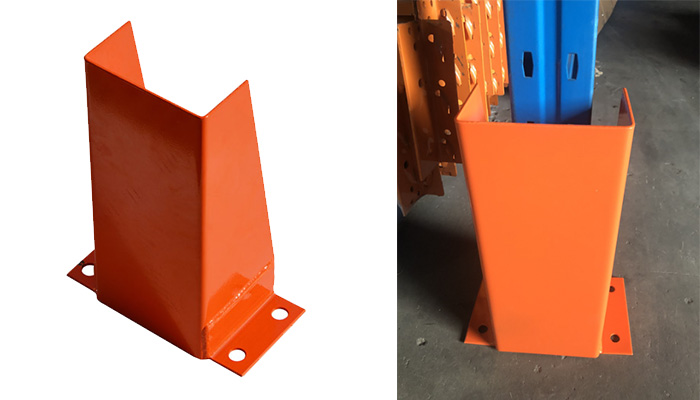
A column guard wraps around the upright base.
It absorbs forklift hits. Without it, one small impact can weaken the frame.
Anchor Bolt / Floor Fixing

Anchor bolts fix the rack to the floor.
Concrete thickness and strength matter. If the floor is weak, anchors fail even if steel is strong.
Safety Lock / Beam Lock

A beam lock stops beams from lifting out.
It is small, but it saves lives during impact or earthquake events.
Design & Layout Terminology
Aisle Width
Aisle width is the clear space for equipment movement.
It depends on forklift type and pallet size. Narrow aisles raise density but slow manual work.
Storage Density
Storage density shows how much you store in a given space.
You increase density with deeper lanes or taller racks. You often trade access speed for density.
SKU
A SKU is one unique product unit.
High SKU count favors selective racking. Low SKU count with high volume favors dense systems.
Throughput
Throughput is how fast goods move in and out.
High throughput needs clear access and simple flow. Dense racks can reduce throughput if not planned well.
Installation & Project Terms
Installation Drawing / Layout Drawing
Installation drawings guide on-site work.
They show bay count, beam levels, and anchors. Clear drawings reduce install time and errors.
Load Sign / Capacity Plate
A load sign shows rated capacity.
It is often required by law. You should place it where operators can see it.
Container Loading
Container loading covers packing racks into containers.
Good loading reduces freight cost and damage. It also speeds up unloading at site.
Common Warehouse Rack Term Confusion
Shelving ≠ Pallet Racking
Shelving is for light goods. Pallet racking is for forklifts and heavy loads.
Load per Level ≠ Total Load
One level rating does not equal total bay rating. Mixing these causes overload.
Drive-In ≠ Drive-Through
One controls stock by LIFO. The other by FIFO. Using the wrong one breaks inventory rules.
Using Warehouse Rack Terminology with Suppliers
When you use correct warehouse rack terminology, you gain control.
You explain needs faster. Quotes become clear. Drawings match reality. Custom racks fit your site on the first try.
Real Case Example
In 2022, an Amazon fulfillment center in Texas upgraded part of its selective pallet rack to push back racking. The team first aligned on terms like load per level, aisle width, and throughput. The result was a 18% increase in pallet positions without slowing picking speed. Clear terminology avoided redesign and saved weeks of work.
Conclusion
When you understand warehouse rack terminology, you reduce risk at every stage. You design better layouts, buy the right system, and install with fewer errors. Clear words lead to strong racks, safe work, and better use of space. OKE Storage is one of China’s top racking and shelving manufacturers, specializing in industrial and commercial storage systems. We provide complete solutions including design, manufacturing, installation, and after-sales service.If you have any problems,you can contact us right now!
FAQ
How do you choose the right warehouse rack terms for a project?
You start with load, pallet size, and handling equipment. Then you match terms to drawings and quotes.
Why is load rating the most critical term?
Because wrong load terms can cause collapse, injury, and legal risk.
Where should you check official rack capacity information?
You should check the load sign, supplier drawings, and engineering documents together.
 EN
 PT
 ES
 AR
 RU
 FR
