
Choosing between pallet support and wire decking is a common question when a warehouse upgrades pallet racking. Both products help pallets sit more safely on rack beams. Both can reduce product damage and improve daily work. But they do not solve the same problem in the same way.
Pallet support is a simple steel support bar for pallet loads. Wire decking is a full wire mesh shelf that covers the beam opening. If your warehouse stores only standard pallets, pallet support may be enough. If you store cartons, split cases, loose items, or mixed pallet types, wire decking often gives better safety and easier handling.
This guide compares pallet support vs wire decking in simple terms, so you can choose the right rack accessory for safety, cost, load type, and warehouse speed.
What Is Pallet Support
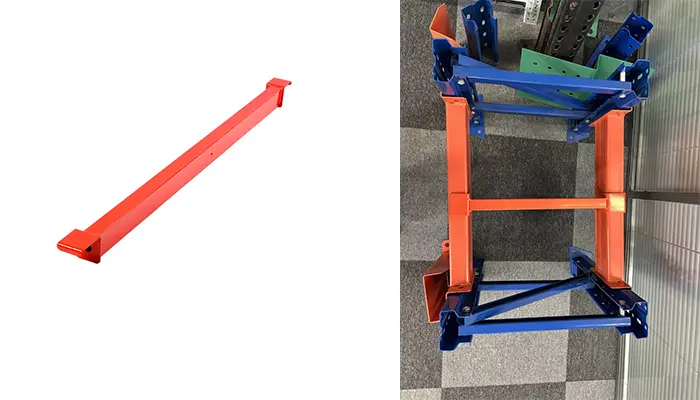
Pallet support, also called a pallet rack support bar or cross bar, is a steel bar installed from the front rack beam to the rear rack beam. It gives extra contact points under the pallet. Most pallet supports sit inside the beam step or connect to the beam with screws or tabs.
The main job of pallet support is to keep a pallet stable when it sits on rack beams. It is not a full shelf. It is best used with palletized loads that are strong, standard in size, and placed correctly by the forklift operator.
Advantages of Pallet Support
Pallet support is usually the lower-cost choice. It uses less steel than wire decking and is simple to add to an existing rack bay. For warehouses with many uniform pallets, this can make a big difference in total project cost.
It is also strong for the right use. Heavy-duty steel support bars can help distribute pallet weight and reduce the risk of a pallet sagging between beams. Some styles, such as roll-in support bars, are fast to install. Other styles, such as hat or double-flange supports, can be fixed to the beam for a more secure fit.
Pallet support also keeps the rack open. This can help air flow through the rack and may reduce dust build-up compared with solid decking.
Disadvantages of Pallet Support
Pallet support does not cover the full shelf opening. Small boxes, cartons, loose inventory, tools, or damaged pallets can still fall between the beams. For this reason, it is not the best choice for upper rack levels where people may work or walk below.
It also needs more careful pallet placement. Forklift operators must place each pallet so it rests well on the beams and support bars. If pallets are not centered, the load may be less stable. This can slow work on high rack levels or in fast-moving aisles.
Pallet support is less flexible for mixed storage. If your warehouse often stores open cases, split pallets, irregular pallets, or non-palletized products, support bars may leave too many open gaps.
Cost of Pallet Support
Pallet support is often the more budget-friendly option. Search results from material handling suppliers commonly show pallet supports costing less per pallet position than wire decking. The final price depends on steel type, beam depth, support style, load rating, and order quantity.
Installation cost can vary. Some pallet supports drop into place, while others should be screwed or fixed to the beam. If many bays need secure fastening, labor time can increase.
Applications of Pallet Support
Pallet support is a good fit for warehouses that store standard pallets with stable bottom boards. It works well for full pallet storage, low to middle rack levels, reserve storage, and operations where each pallet is handled carefully.
It is also useful when the warehouse wants to improve pallet rack safety without paying for full wire mesh coverage on every level. Many facilities use pallet supports on lower levels and use wire decking on higher or more active levels.
What Is Wire Decking
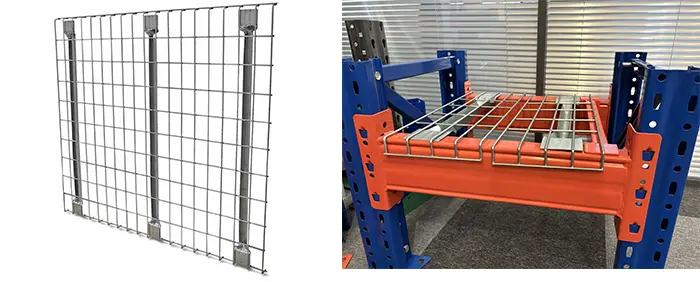
Wire decking is a welded steel wire mesh panel that sits on pallet rack beams. It usually has support channels under the mesh. Common styles include waterfall wire decking, flush wire decking, and flared channel wire decking.
The main job of wire decking is to create a safer shelf surface inside the pallet rack. It supports pallet loads, but it also helps support cartons, loose items, and products that are not on a full pallet. The open mesh design lets light, air, and sprinkler water pass through the rack.
Advantages of Wire Decking
Wire decking gives a larger support surface than pallet support bars. This makes loading easier because the pallet does not need to be placed as perfectly on the support points. It can help forklift operators work faster and reduce handling mistakes.
It also improves fall protection. The wire mesh helps stop cartons, loose items, broken pallet boards, and small products from dropping through the rack. Waterfall wire decking adds a front and rear lip that hooks over the beam and helps keep the deck in place.
Wire decking is often preferred for fire safety because the open grid lets sprinkler water pass through better than solid wood or particle board. It also allows better visibility, air flow, and cleaner storage because dust is less likely to collect on a solid shelf.
Another key benefit is flexibility. Wire decking can hold pallets, cartons, bins, hand-loaded stock, and mixed products. This makes it useful for warehouses that change SKUs often or handle e-commerce, retail, manufacturing parts, food service goods, or distribution products.
Disadvantages of Wire Decking
Wire decking usually costs more than pallet support bars. It uses more material and covers the full bay depth. For a large rack project, the price difference can become important.
Wire decking also has load limits. A deck rating is based on evenly distributed load, and the deck does not increase the capacity of the rack beams. The beam capacity, upright capacity, pallet weight, and load distribution still matter.
It may not be the best option for very heavy point loads, special pallets, or products with small feet that press into the mesh. In these cases, a rack engineer or supplier may recommend stronger decking, extra channels, pallet supports under the deck, bar grating, or another rack solution.
Cost of Wire Decking
Wire decking is usually more expensive than pallet support, but it may reduce risk and labor cost over time. Common supplier information shows standard wire decks often rated around 2,500 pounds per deck or section under evenly distributed load, with higher ratings available depending on channel count, wire gauge, size, and design.
Installation is usually simple. Many wire decks drop directly onto step beams with no tools. This can save time during setup, especially when compared with support bars that need screws or fixed hardware.
Applications of Wire Decking
Wire decking is a strong choice for upper rack levels, carton storage, split-case storage, mixed pallets, loose products, hand-loaded inventory, and busy forklift aisles. It is also useful where fire sprinkler performance, visibility, and fall protection are important.
Warehouses often choose wire decking for distribution centers, retail storage, 3PL operations, food and beverage storage, automotive parts, manufacturing parts, and e-commerce fulfillment.
Pallet Support VS Wire Decking
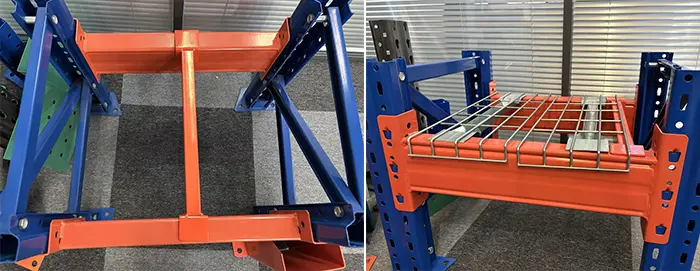
| Factor | Pallet Support | Wire Decking |
| Main purpose | Adds steel support points under pallets. | Creates a wire mesh shelf surface across the rack bay. |
| Best for | Standard palletized loads. | Pallets, cartons, split cases, bins, and loose items. |
| Safety | Good when pallets are placed correctly. | Better fall protection because the mesh covers open gaps. |
| Loading ease | Requires more accurate pallet placement. | More forgiving and easier for fast loading. |
| Fire sprinkler flow | Open design allows air and water flow. | Open mesh allows strong sprinkler water pass-through. |
| Cost | Usually lower cost. | Usually higher cost, but more flexible. |
| Installation | Drop-in or screw-fixed, depending on style. | Often drops into place with no tools. |
| Flexibility | Limited for non-palletized goods. | High flexibility for mixed warehouse storage. |
| Common choice | Budget-focused pallet rack support. | Safety-focused and multi-use rack decking. |
Conclusion
Pallet support is suitable for warehouses that store standard pallets, want a lower-cost rack accessory, and have operators who can place pallets correctly on the beams. It is a practical choice for stable pallet loads and budget-focused rack upgrades.
Wire decking is suitable for warehouses that need better fall protection, easier loading, better support for cartons or loose items, and stronger flexibility for changing inventory. It is often the better choice for upper levels, mixed storage, and busy operations where speed and safety both matter.
The best choice may also be a mix. Use pallet support where pallet loads are simple and low risk. Use wire decking where people, products, and daily workflow need more protection.
Get a Quote for Pallet Support or Wire Decking
Need help choosing pallet support vs wire decking for your warehouse? Send your rack size, beam depth, pallet size, load weight, and storage type. OKE team can help you compare the right option, check the load needs, and prepare a clear quote for your pallet rack project.
 EN
 PT
 ES
 AR
 RU
 FR
