
Among the many warehouse storage solutions, pallet racking and mezzanine floor are two of the more popular types of racking, but there are many differences between them, and today OKE Storage will take you through the differences between these two types of storage racking to help better meet your storage needs.
The main differences between the warehouse mezzanine floor and traditional warehouse racking are as follows:
- Mezzanine floor racking available ground space, mainly through the pallet racking as the core framework, vertical structure, and the formation of new floors, so that its own warehouse space more than double or even triple the floor space, this three-dimensional structure can make full use of the warehouse space.
You can both the normal use of pallet racking, but also the use of the floor space, to expand the storage capacity of the warehouse; the traditional selective pallet racking is Installed directly on the warehouse floor.
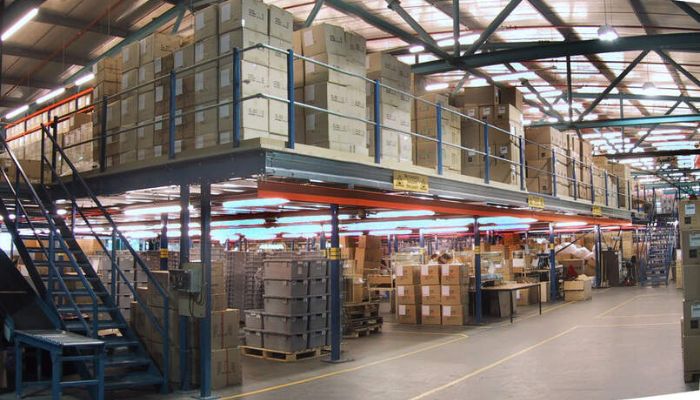
- Mezzanine floors in addition to the traditional pallet rackings will have uprights, beams, decking, back of the network, guardrail, and other components, there are mezzanine floor, stairs, stairway connection, floor options, security locks, and other components.
Similar to the stairs is the use of thickened non-slip treads, both sides of the handrail heightened, to prevent people from slipping or stepping into the void, to ensure that the experience of using the confidence and safety.

- Mezzanine floors have a stronger carrying capacity and are not easily deformed, each layer can carry 500 kg, and the floor can carry 300 kg to 1000 kg per square meter, which can meet the needs of more inventory quantity storage management.

4. The spacing between the layers and layers of mezzanine floor racking is generally between 2.2m-2.7m, and the height of the top shelf is generally around 2m, with no restriction on the width of the aisle and the width of the racking, whereas the width of the aisle of the traditional adjustable pallet racking is around 3.2m, and the width of the shelves is around 2.4m.
5. The floor of the mezzanine racking system is generally made of steel plates or wooden boards, with specialized patterned steel plates, flat steel plates, and perforated steel plates to meet different needs.
The floor holes are available in Type II long holes and round holes, all of which comply with fire safety standards in various countries.
The entrance to the mezzanine is often chosen to be made of diamond plate flooring, while mezzanines for outdoor facility storage tend to use metal deck plates. Other common floor types include grating plates, B-decks, and plywood floors. Traditional pallet racking systems do not need to consider this aspect.

- The mezzanine floor system is not only suitable for storing goods but also for conveying systems, heavy equipment, or machinery. It is widely used in industries such as automotive parts, electronics, etc.
On the other hand, pallet racking systems are specifically designed for storing goods on pallets and can meet the storage needs of heavy goods. They are widely used in logistics, warehouses, and distribution industries.
Summary
Both mezzanine floor racking and pallet racking have their benefits and both systems can provide an efficient storage solution.
If you want to achieve fast access then pallet racking is the way to go, there are many categories of pallet racking and if you want to expand the storage area of your warehouse then structural mezzanine racking is ideal. This short blog will hopefully help you in choosing the right and appropriate system for you.
But before making any decisions you should consider contacting OKE Storage, as you will receive a fast, free, and suitable quote and drawing design, contact us now!
 EN
 PT
 ES
 AR
 RU
 FR
