
Pallet racking is probably one of the most common and critical of equipment in your warehouse. They support the efficiency of your entire supply chain, but do you truly understand pallet racking safety standards? Keeping on these regulations is not just about compliance, it’s about protecting your employees and minimizing losses. This article will take you through the pallet racking safety standards and regulations, helping you avoid risks and build a safer storage environment.
Why Pallet Rack Safety is Critical?
Common safety hazards
Pallet racking may look sturdy, but actually many potential risks. If you overload them, stack them improperly, or neglect routine inspections, they are likely to collapse. Some common problems include:
– Uneven stacking of pallets
– Deformed pallet racking uprights
– Forklifts hitting the racking and loosening the structure
These may seem like small things, but they can all lead to big accidents.
Possible consequences of an accident
A rack collapse accident can result in employee injuries and even death. Damaged goods can also leave you liable for hefty damages, and you may be penalized by regulators.For example, in 2022, a logistics company in Toronto, Canada, was fined more than $150,000 for a rack collapse accident that injured two workers.
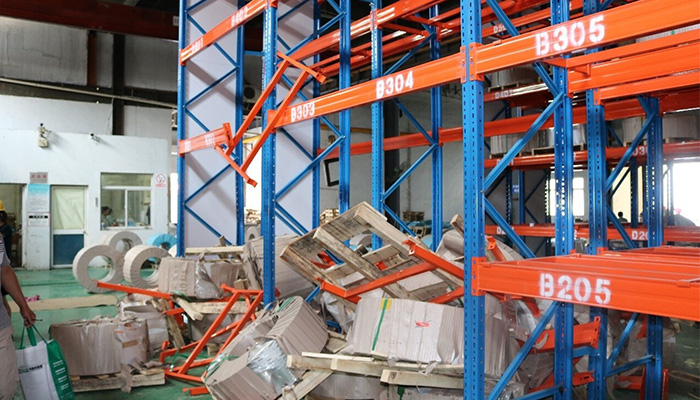
The impact of safety on operational efficiency
Safety is more than just avoiding accidents. Stable racks and used properly also improve operational efficiency. You’ll be able to find goods faster and forklifts will operate more smoothly. And in the event of an accident, not only do you have to stop work to deal with it, but you also disrupt the entire supply chain.
Safe Use Guidelines for Pallet Racks
Load limits and load marking
You must be aware of the maximum load capacity of each rack. Racks should be clearly labeled with load signs. Don’t stock by feel. Signs should state the maximum load for each tier and the entire group of racks.

Anti-collision protection device
The uprights of racks are easily hit by forklifts. You should add crash guards and column protectors. These small accessories don’t cost much, but they can greatly reduce the risk of structural damage.

Proper stacking and forklift operation tips
Pallets should be placed flat and symmetrically on the beams. Do not let the goods stick out of the crossbeams. Forklift drivers must be trained to learn to place goods correctly and avoid slamming into racks.
Regular maintenance and safety inspection system
It is important to establish a routine inspection regime. Weekly visual inspections and quarterly structural inspections. Schedule these into your workflow.

Inspection and Maintenance Recommendations
Daily and periodic inspection contents
You should briefly check your racks daily for tilts, cracks or loose screws. A more detailed monthly inspection is required including:
– Uprights for deformation
– Whether the beam connectors are secure
– Rust or scratches
– Whether the load-bearing markings are clear
Advantages of using a professional inspection service
A professional company will use laser instruments, torque tools, and other equipment to conduct more accurate inspections. They can also provide a written report for your compliance filing.
Record keeping and compliance audit requirements
It is important to keep records of your inspections. These documents are proof of your compliance. In the event of an incident or inspection, complete records can relieve you of legal liability.
Staff Training and Safety Culture
Train employees to recognize and respond to safety risks
All warehouse employees must be trained in the use of pallet racking. Training includes recognizing damage, reporting risks, and proper handling methods.
Establish a safety system and responsibility system
Set up a person in charge of safety and hold regular safety meetings. Define each employee’s responsibilities. For example, who is responsible for daily inspections and who is responsible for reporting damage.
The role of safety awareness in corporate culture
Safety should not be just a paper system, but part of the culture. Allow employees to proactively identify problems, rather than reactively responding to them after something goes wrong.
Choosing a Compliant Pallet Rack Supplier
Supplier’s certification qualification and past cases
You should choose suppliers with ISO or CE certification. They usually pay more attention to quality control and have rich experience. You can ask to see their past customer cases.
Compliance with local regulations and international standards
Each country has different safety norms. You need to ensure that your supplier’s products comply with local laws. For example, in the U.S., comply with RMI (Rack Manufacturers Institute) standards.
Ability to provide installation and after-sales support
A good supplier should provide installation services. The quality of rack installation directly affects the safety of use. After-sales service is equally important to facilitate your repair or replacement parts.
Conclusion
Pallet racking may seem simple, but it actually contains many safety details. From load-bearing management to employee training, every aspect can affect the overall operation.
You need to have a clear understanding of local regulations, select compliant suppliers, establish regular inspection mechanisms, and encourage employees to participate in building a safety culture. Only in this way can your warehouse operate efficiently while ensuring the safety of personnel and assets.
FAQ
1.How many times per year must pallet racking be inspected?
Recommend to a comprehensive structural inspection at least once a quarter, and a visual inspection on a daily basis. The specific frequency can be adjusted appropriately according to the intensity of racking use.
2.What are the consequences if the standards are not met?
You could face fines, work stoppages, and in severe cases, injuries and lawsuits. Compliance is the first step in avoiding risk.
3.How to determine whether the rack is overloaded?
Check the load marking on the rack. Calculate whether the total weight of goods exceeds the marked value. Overweight pallets can lead to beam bending or structural instability.
4.Where can I find suppliers that meet the standards?
You can find certified racking suppliers through industry association websites (such as RMI or SEMA), large warehouse equipment trade shows, or official websites of reputable brands.
 EN
 PT
 ES
 AR
 RU
 FR
